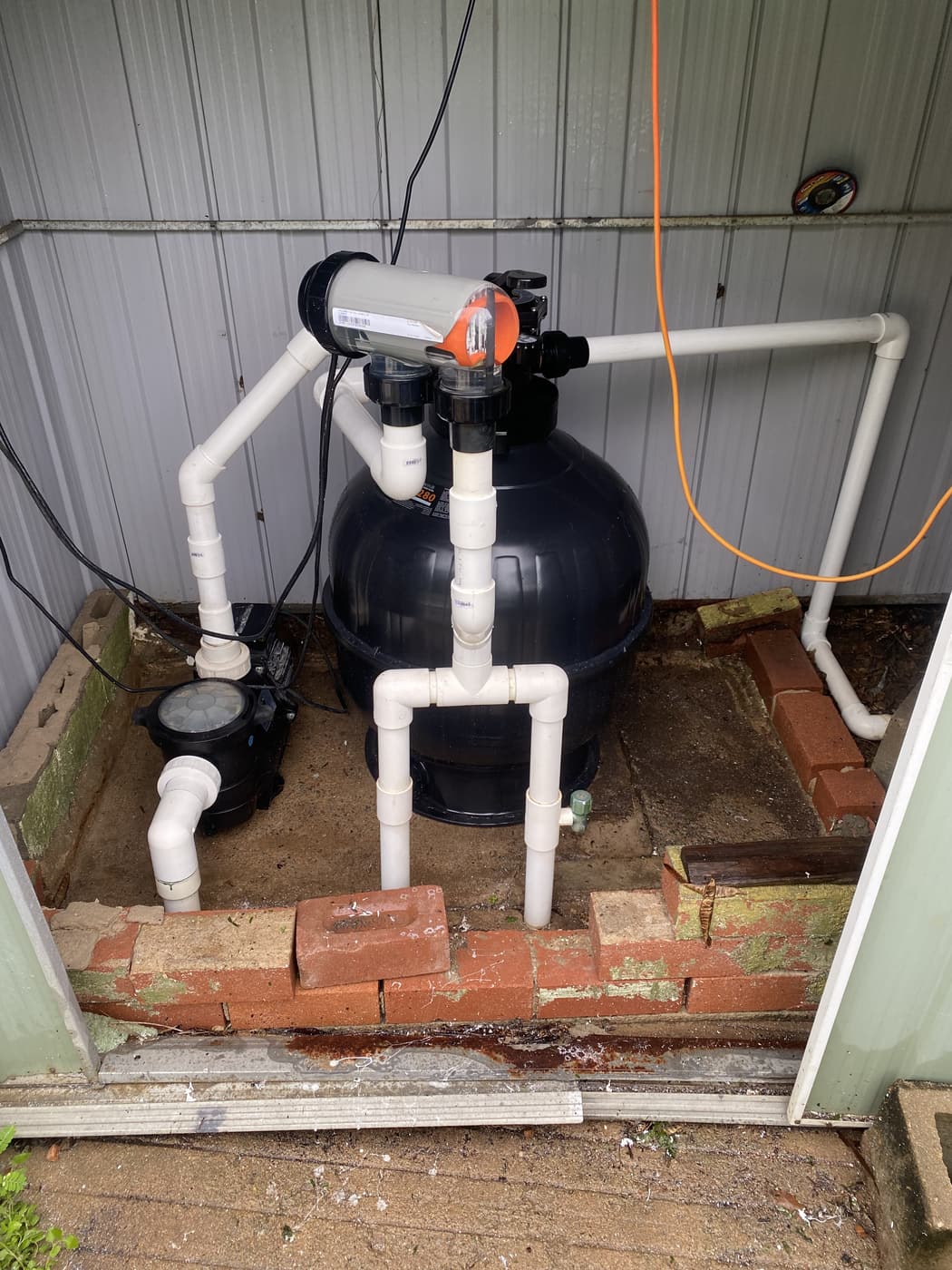
A salt chlorinator makes chlorine by passing a low-voltage current through salty water as it flows over a set of coated titanium plates inside the cell. The same process raises the pH at the plate surface, and that causes calcium in the water to deposit as white scale. As scale builds up, the plates have less clean surface to work with and chlorine output drops.
Townsville pools run their chlorinators long and hard over summer, so the cell does a lot of work and scale has plenty of chance to build.
How to inspect the cell
- Turn the power off to the pump and the chlorinator at the power point. Close isolation valves if your system has them.
- Unscrew the cell from its housing or unions, following your manufacturer's instructions. Some cells come out from the top, others unscrew at both ends.
- Look at the plates. Clean plates show the coated metal with little or nothing between them. Scale shows as white or grey crust, flakes, or a chalky build-up bridging the gaps between plates.
- Check the O-rings and the cable connection for damage or corrosion while it is out.
Many chlorinators show a "check cell" or low output warning on the controller. Treat that as a prompt to inspect, but don't wait for it. In summer, a look every couple of months is a reasonable habit. Cells with self-cleaning (reverse polarity) still scale up when pH and calcium run high, just more slowly.
Cleaning the cell with a diluted acid soak
Light scale can sometimes be rinsed off with a hose. Heavier scale needs a soak in diluted hydrochloric acid. Your chlorinator manual is the authority here: it gives the recommended dilution and soak time for your cell, and using a stronger mix or a longer soak can strip the plate coating.
Safety first. Always add acid to water, never water to acid. Wear chemical-resistant gloves and eye protection, work outdoors in a ventilated spot, and use a plastic bucket or the manufacturer's cleaning stand. Keep children and pets well away and rinse any splashes off skin immediately with plenty of water.
- Fill a plastic bucket or cleaning stand with the amount of water the manual specifies, then add acid slowly to reach the stated dilution.
- Stand the cell in the solution so the plates are covered but the cable connection stays dry.
- Watch the fizzing. When it stops, the scale has dissolved. Don't leave the cell sitting longer than the manual allows.
- Rinse the cell thoroughly with fresh water and check that the plates are clear.
- Refit the cell, open the valves, restart the pump and then the chlorinator.
- Dispose of the used solution according to local rules. Don't tip it into a garden bed or the stormwater drain.
Never scrape the plates with a screwdriver or wire brush. Scratching damages the coating, and the coating is what makes the cell work.
Keeping salt and pH in range
Salt level matters as much as clean plates. Too little salt and the cell can't make enough chlorine and may wear faster. Too much wastes salt and can trigger warnings on some controllers.
| Reading | Typical range | If it's out of range |
|---|---|---|
| Salt | Typically 3,000 to 5,000 ppm | Low: add pool salt. High: partially drain and refill |
| pH | 7.2 to 7.6 | High pH speeds up scaling, so lower it with acid |
| Total alkalinity | 80 to 120 ppm | High alkalinity keeps pushing pH up |
| Stabiliser (cyanuric acid) | 20 to 50 ppm | Low: chlorine burns off fast in Townsville sun |
Salt ranges vary between brands, and low-salt and mineral systems run lower, so check your chlorinator's manual for the exact figure. Salt doesn't evaporate, so topping up for evaporation alone won't lower it. It is lost through rain overflowing the pool, backwashing and splash-out, so test after big storms and after a run of backwashes. Keeping pH at the lower end of its range is the most effective way to slow scale build-up.
Signs the cell is near the end of its life
Cells wear out. The plate coating is used up a little every hour the cell runs and every time it is acid cleaned. Watch for:
- Chlorine readings that won't hold, even with a clean cell, correct salt and the pump running enough hours.
- Plates with worn patches, peeling coating or visible bare metal.
- A controller that keeps showing low output or "check cell" after cleaning and with salt in range.
- Scale returning much faster than it used to, so the cell needs cleaning every few weeks.
When this happens, the controller and power supply may still be fine. Often only the cell needs replacing, though it has to be a compatible model.
Getting the cell checked
The chlorinator cell is inspected on every pool service visit, along with the pump, filter and timer. If the cell is starting to scale, it goes in the report emailed after the visit. A failed cell is diagnosed and quoted before any work is done, and replacement chlorinator cells can be supplied at supplier cost. On a regular pool maintenance schedule, the salt and pH readings are tracked over time, which shows the slow drift that leads to scale.
A scaled cell is a common cause of water that goes dull before it goes green, which our cloudy pool water guide covers. If the cell is clean and the chlorine still won't hold, check the filter as well: our pool filter cleaning guide explains how to read the pressure gauge.