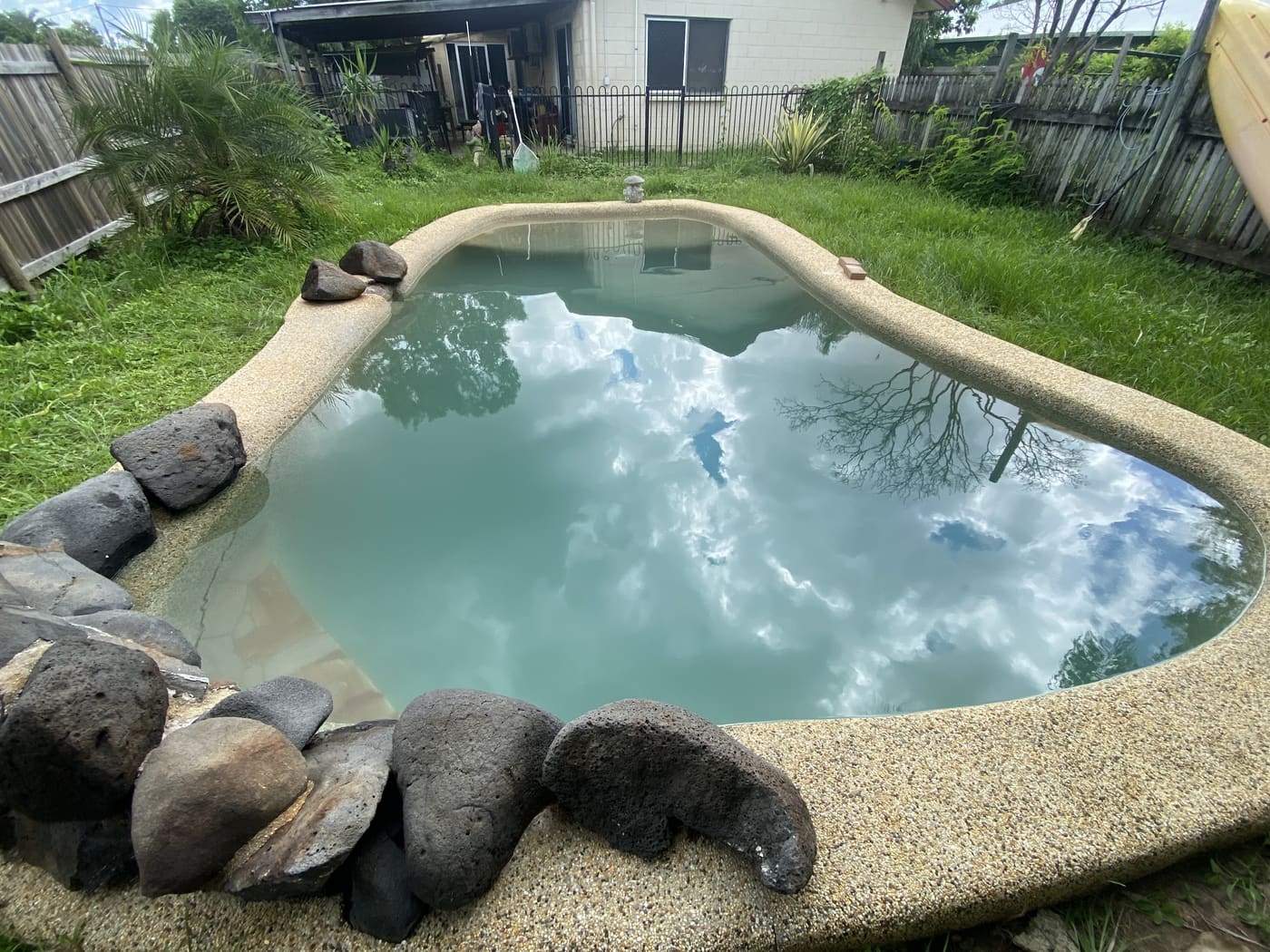
A pool that has gone milky is telling you the water can no longer keep fine particles in check. The particles might be dead algae, calcium coming out of solution, sunscreen and body oils, or fine dirt washed in by rain. Each one has a different cause and a different fix, which is why tipping in a bottle of clarifier without testing often does nothing.
Cloudy is also an early warning. Water that sits cloudy with low chlorine for a few days in Townsville heat is usually green by the end of the week.
Five common causes of cloudy pool water
Low free chlorine. When chlorine drops too low, it stops killing algae and bacteria fast enough. Fine organic matter builds up and the water dulls before it turns green. The ideal range on our pool chemistry guide is around 2.0 ppm. Summer sun and warm water burn chlorine off quickly, so a chlorinator setting that worked in July can fall short in December.
High pH and total alkalinity. Above a pH of 7.6, chlorine works much less effectively and calcium is more likely to drop out of the water as a fine white haze. Total alkalinity above 120 ppm keeps pushing the pH back up after you correct it. Salt chlorinators raise pH as they run, so salt pools drift high more often than most owners expect.
High calcium hardness or dissolved solids. Every litre that evaporates leaves its minerals behind, and the top-up water adds more. Over a couple of years of Townsville summers, calcium and total dissolved solids (TDS) build up until the water can't hold them, especially when the pH is also high. This type of cloudiness looks chalky and often comes with scale on tiles and the chlorinator cell.
The filter isn't running long enough, or it's dirty. The filter is what physically removes the particles. A pump on a short timer, a clogged cartridge or a sand bed that hasn't been backwashed will leave fine haze in the water even when the chemistry is right. Our guide to pool filter cleaning covers how to tell when it needs attention.
Heavy bather load or storm runoff. A pool party on a 35-degree day adds sweat, sunscreen and a lot of chlorine demand in a few hours. In the wet season, heavy rain dilutes the chlorine, shifts the pH, and washes soil, leaves and fertiliser in from the garden. Pools near lawns and garden beds go cloudy after a storm more than pools surrounded by paving.
Match the cloudiness to a test reading
Test free chlorine, pH, total alkalinity and stabiliser (cyanuric acid) before adding anything. If you have a salt pool, test salt as well. The table below links what you see in the test to the likely fix.
| Likely cause | Test reading | Fix |
|---|---|---|
| Low chlorine | Free chlorine well under 2.0 ppm | Shock dose with liquid or granular chlorine, then raise the chlorinator output or run time |
| High pH | pH above 7.6 | Add hydrochloric (muriatic) acid in small doses and retest after a few hours of circulation |
| High alkalinity | Total alkalinity above 120 ppm | Lower gradually with acid over several days, keeping the pump running |
| Too much stabiliser slowing the chlorine | Cyanuric acid well above 50 ppm | Partially drain and refill with fresh water |
| Calcium or TDS build-up | Chlorine and pH fine, water chalky, scale on tiles | Bring pH down first, then partially drain and refill if it won't clear |
| Filtration | Chemistry in range but water still hazy | Clean or backwash the filter and run the pump longer |
How to clear a cloudy pool, step by step
Fixing things in the wrong order wastes chemicals. Chlorine added to high-pH water does far less work, so balance first.
- Test the water. Use a fresh test kit or take a sample to a pool shop. Write the numbers down so you can compare them after each step.
- Correct pH and alkalinity. Bring the pH back to 7.2 to 7.6 with acid. Add it slowly near a return jet with the pump running, and never mix pool chemicals together.
- Raise the chlorine. Once pH is in range, shock dose to lift free chlorine well above normal, following the product label for your pool volume.
- Clean the filter and run the pump. Backwash a sand or glass filter or hose out the cartridge, then run the pump continuously for 24 hours.
- Brush and vacuum. Brush the walls and floor so settled matter gets back into the water where the filter can catch it.
- Retest after 24 to 48 hours. If the chemistry is right and the water is still hazy, a clarifier helps the filter catch fine particles. For heavy cloudiness, a flocculant drops everything to the floor so you can vacuum it to waste.
- Deal with minerals last. If calcium or stabiliser is the problem, a partial drain and refill is usually the only real fix.
Keep the chemical containers sealed and stored apart, wear eye protection when handling acid, and follow the label on every product. Never add two chemicals to the pool at the same time.
Stopping it coming back in the wet season
Most cloudy pools in Townsville show up between December and March. The heat pushes chlorine demand up and the storms bring in debris and dilute the water. A few habits make a big difference over those months:
- Test at least weekly, and again after any heavy downpour.
- Run the pump longer in summer. A common rule of thumb is to turn the full pool volume over at least once a day, which for most domestic pools means eight hours or more.
- Empty the skimmer and pump baskets after storms, since a blocked basket cuts flow through the filter.
- Check the salt chlorinator cell for scale. A scaled cell makes less chlorine, and the drop often shows up first as dull water. Our salt chlorinator cleaning guide covers how to check it.
A regular service catches these drifts before you can see them. On a pool maintenance schedule, the readings from each visit are recorded and emailed with photos, so a pH that creeps up week by week gets corrected before the water turns.
When to call a pool technician
Call for help if the water is still cloudy after 48 to 72 hours of correct chemistry and continuous filtering, if it has started to turn green, or if the pump, filter or chlorinator doesn't seem to be working properly. Those signs usually point to an equipment fault or a chemistry problem that home test strips don't pick up.
A pool service visit starts from $75 for pools up to 35,000 litres and covers water testing and dosing, a full clean, a filter clean and an equipment check, with a photo and chemistry report emailed afterwards. Chemicals are charged separately at supplier cost. If the pool has already gone green, green pool recovery is a separate job, from $300 for pools up to 65,000 litres.